
'We suggest an equity strategy of 5% to 10% exposure to cash, 5% to Gold ETF, close to 50% to Sensex/Nifty/large mid-cap stocks.'

The general elections in April/May 2024 are expected to add volatility to the Indian markets, keeping investors on their toes.

India's image as a safe investment destination has been further cemented by the post-poll stock market rally and global investors would keep coming in with huge funds during 2009, ICICI Securities' chief Madhabi Puri Buch said on Thursday. The MD and CEO of the country's top equity brokerage house said that in less than two and half months of the current fiscal, FIIs have already pumped in $6.3 billion.

'The probability of this being a suckers' rally, where all kinds of beaten down stocks have begun to rally sharply, should be a time to be cautious and circumspect.'

Global markets could correct 5-10 per cent. If that happens, Indian markets will correct about 10 per cent

'It is a fiercely fought battle, like our fiery chillies in Guntur.'

But experts say downside limited, pockets of opportunities for investors

Foreign Portfolio Investors (FPIs) selling spree continued as they dumped Indian equity worth over Rs 5,800 crore this month so far on rising interest rates and geopolitical tensions in the Middle East. This came after such investors withdrew Rs 24,548 crore in October and Rs 14,767 crore in September, data with the depositories showed. Before the outflow, FPIs were incessantly buying Indian equities in the last six months from March to August and brought in Rs 1.74 lakh crore during the period.

After rallying 543 points in the morning session and touching the 40,000-mark, the BSE Sensex surrendered all gains to close at 38,628.29, showing a loss of 839.02 points or 2.13 per cent. Similarly, the NSE Nifty tanked 260.10 points or 2.23 per cent to end at 11,387.50.

Tata Consultancy Services' (TCS') contribution to the overall market capitalisation (mcap) of listed Tata group companies has slipped below 50 per cent for the first time in over a decade. This has happened amid a rally in other Tata stocks, led by smaller companies, even as TCS, the group's largest company by mcap, has lagged. In recent quarters, Tata's listed firms have emerged as leading performers on the bourses, with the group's combined mcap crossing Rs 30 trillion early last week - a first for a private sector conglomerate.

'This market is very expensive in some pockets, dirt cheap in some, and the belly of the market is reasonably valued.'
Within a day of slipping out of the coveted league of countries with trillion-dollar-size stock markets, India today regained this status as a 510-point strong Sensex rally boosted its market capitalisation to $1.02 trillion.

Focus will, however, shift back to corporate earnings, liquidity situation and global events - specially crude price.

Notwithstanding the recent sharp decline in the stocks of public sector companies, analysts at Jefferies remain bullish on this segment. State Bank of India, Coal India, and NTPC are their top picks in this space, they said in a recent note. The public sector undertaking (PSU) or state-owned enterprise (SOE) index, with a 70-percentage-point outperformance versus the National Stock Exchange Nifty50 over the past 12 months, comes after a decade of underperformance before 2020.

On an overall basis, Nomura believes the economic conditions are suited for equity markets. The brokerage is predicting the market performance will be better in the first half of 2020 and "somewhat weaker" in the second half.

'Higher than expected inflation in the US or the European Union, faster than expected tightening by the major central banks, break out of a war in Europe, and withdrawal of portfolio equities from the emerging markets are factors which can result in equity market corrections.'
Bharti group's Sunil Mittal retained his fourth position, followed by Wipro's Azim Premji at the fifth slot.

Chances of a sudden collapse in the Shanghai Composite are remote.
Shares of public sector enterprises have corrected by up to 22 per cent month-to-date until March 19, 2024. Analysts attribute this steep fall to the valuation exuberance seen after a sharp run in these counters last year and suggest investors remain selective regarding the stocks in this space. "The rally in public sector undertaking (PSU) stocks has been stretched and sharp, although it is somewhat justified by improvements seen in earnings, operations, balance sheets, and overall profitability.

Indian stock markets are likely to remain bullish during the current Hindu calendar year (Samvat 2071) and investors would continue to reap rich gains, say experts.

'When honest, wealthy people come forward to serve India, people should feel proud and welcome them.'

With global markets pushing ahead, enthused by strengthening US jobs market, and also due to prospects of European rate hike, Indian markets also continued the march ahead.
The group began to outperform the broader market only with the onset of the pandemic in March 2020 while earlier it was largely keeping pace with the Sensex. The group's market cap is up 164.4 per cent since the end of March 2020 against a 105 per cent rally in the Sensex.

Fiscal pressure for the Indian economy is gradually rising, suggested analysts at Jefferies in a recent note, as oil prices (Brent) - which are close to the $100 a barrel mark - continue to climb ahead of a busy election calendar. They added that the sharp rally in the equity markets during the last few months has made valuations costly. As a result, Jefferies expects the Indian markets to remain choppy in the near term.
Nifty saw the biggest weekly gain since the first week of September and comfortably maintained its crucial 8250 levels in today's session

The market capitalisation of BSE-listed firms jumped to an all-time high of Rs 304.53 lakh crore on Wednesday, buoyed by an unprecedented rally in equities where the BSE benchmark Sensex ended over the 67,000-mark for the first time ever. Rallying for the fifth day running, the 30-share BSE Sensex climbed 302.30 points, or 0.45 per cent, to end at its lifetime closing high of 67,097.44 points. During the day, it jumped 376.24 points, or 0.56 per cent, to reach its all-time intra-day peak of 67,171.38 points.

The RBI is fully aware that the high-cost loans and high indebtedness of the borrowers could pose financial stability risks, if not addressed by these NBFCs. Governor Shaktikanta Das has issued a stern warning, saying the RBI is closely monitoring these areas and will not hesitate to take appropriate action, if necessary, if the culprits don't opt for self-correction. Watch out for some action, soon, notes Tamal Bandyopadhyay.

The Nifty IT index, data shows, has outperformed the markets in each of the last four election years post the result. announcement.

Yes Bank was the biggest gainer in the Sensex pack, rallying 11.48 per cent amid reports that private equity firms have showed interest in buying a major stake in the private sector lender.

The Indian equity market clocked record average daily turnover (ADTV) in both the cash and derivatives segments in February amid a spike in volatility. The ADTV for the cash segment for both the exchanges combined came at Rs 1.27 trillion, while the same for the derivatives or the futures and options (F&O) segment stood at Rs 483 trillion in the previous month. The volumes for both cash and derivatives have almost doubled from a year ago on the back of rising retail participation in the world's fourth largest equity market.

The RBI's financial stability report has on Wednesday highlighted the disconnect between the real economy and equity market yet again. The central bank observed that Indian equities were trading at rich valuations, with several metrics such as price to earnings multiples, price to book ratio, market cap to GDP and the cyclically adjusted P/E ratio, or Shiller P/E, at above historical averages. For instance, as on December 13, the one-year forward P/E ratio for India was 35.1 per cent, above its 10-year average, and one of the highest in the world.

There are overvaluation and excesses in many pockets of the market. This is most obvious in the IPO market, where loss-making companies have inflicted large losses on investors, observes Debashis Basu.

Eighty per cent, or 60 of the 75 companies that made their debut on the mainboard this financial year, ended their listing day with gains.
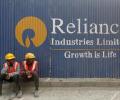
Reliance Industries Limited on Wednesday became the first Indian company to hit the Rs 19 lakh crore market valuation mark following a rally in its share price. The market heavyweight stock jumped 1.85 per cent to its record high of Rs 2,827.10 on the BSE. Following the gain in the share price, the company's market valuation jumped to Rs 19,12,814 crore in morning trade on the BSE.
ITC stock slipped over 4 per cent on Thursday (February 8) after British American Tobacco (BAT) said it could sell some of its stake in the company, recovering partially in trade. The stock of the cigarette-to-hotels conglomerate traded at Rs 420 levels, rising 1.3 per cent in intraday deals as compared to the S&P BSE Sensex that traded flat for most part of the day. The development, meanwhile, saw Jefferies downgrade the stock to 'hold' from 'buy' earlier with a target price of Rs 430, down a huge 17.3 per cent from its earlier price target of Rs 520.

According to experts, work from home, volatility in stock markets worldwide, and redemption pressures compelled investors to defer new investment plans.

The markets tend to react six to eight months in advance

The specter of how the Munambam issue was exploited during the November by-elections is proof of the price Kerala is paying for its emergent politics. Controversies become the stuff of slow-burn and brinkmanship. The former promises mileage; the latter searches for an advantage, notes Shyam G Menon.
RIL became the first Indian company to hit the Rs 9.5 lakh-crore market capitalisation level. Shares of Bharti Airtel soared 7.36 per cent and Vodafone Idea rallied 34.68 per cent after both the companies announced a hike in mobile phone call and data charges from December.
